

Artificial crisis of fertilizers hits Aman farming in Sirajganj
- Update Time : Tuesday, September 1, 2026
Sirajul Islam Shishir:
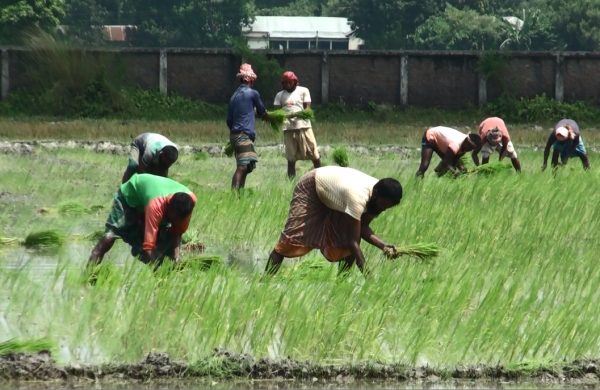
Artificial crisis of fertilizers has become a largest barrier for the Sirajganj farmers as they are not getting it as per their demand even after enough stock according to the government officials’ claim. They are apprehending that, their dream may turn into nightmare, if the necessary measures are not taken right now by the concerned authorities.
Sources said, farmers in the region have started planting Aman seedlings in a full swing due to favourable weather and lack of floods.
However, their efforts are being severely hindered by an artificial shortage of essential fertilizers, inflated prices, and allegations of dealer syndication across the district.
A recent spot visit to several areas—including Shialkol and Bohuli in Sadar Upazila, and Pangasi, Dhangara, Solonga, and Deshigram unions in Raiganj Upazila—revealed widespread frustration among local growers.
Farmers complained that on top of rising fuel prices and escalating costs of agricultural inputs, they are unable to obtain government-subsidized fertilizers at fixed rates. They allege that dishonest dealers have stockpiled inventory to create an artificial crisis and profit off the black market. Many express deep concern that a delay in applying fertilizers will drastically reduce crop yields.
Growers reported that despite official assurances that there is no national fertilizer shortage, supplies remain unavailable at authorized dealer points even after waiting in long queues for hours. However, fertilizers can be easily obtained on the open market by paying significantly higher prices—a situation farmers attribute to a lack of proper monitoring by local authorities.
According to the District Department of Agricultural Extension (DAE), a target has been set to cultivate transplanted Aman across 76,015 hectares of land in nine upazilas of the district this season. Seedbeds have been prepared on 4,120 hectares, and free seeds and fertilizers have been distributed to 14,000 small and marginal farmers under an incentive program.
Data from the Bangladesh Agricultural Development Corporation (BADC) sets the government-fixed retail prices at Tk 19 per kg for Di-ammonium Phosphate (DAP), Tk 25 per kg for Triple Super Phosphate (TSP), and Tk 18 per kg for Muriate of Potash (MoP). However, unable to secure allocations at official outlets, farmers are forced to buy fertilizers on the open market at nearly double the government rates.
Abdul Khalek, a farmer from Solonga in Raiganj, said he needs 7 to 8 bags of fertilizer for his plot but managed to secure only two bags from a dealer after days of trying, and even then at an inflated rate. Another local farmer, Rostom Ali, reported that a bag of DAP with a government-fixed rate of Tk 1,050 is being sold for Tk 1,700. He noted that despite claims of official monitoring, no effective steps have been taken to dismantle the dealer syndicate.
Similarly, Ali Ahmed from Bohuli village in Sadar Upazila stated that when he visited a dealer point needing 50 kg of DAP for vegetable cultivation, he was allocated a maximum of only 10 kg. Farmers Harun Sarkar, Aslam Uddin, Tofazzal Hossain, and Afsar Ali from Raiganj Upazila echoed these complaints, stating that TSP set at Tk 1,350 per bag is being sold for Tk 1,700 to Tk 1,800, marking an extra charge of up to Tk 450 per bag.
Sub-dealers and retail sellers claimed they are also paying dealers an extra Tk 100 to Tk 200 per bag above official rates, leaving them short on supply to meet farmers’ demands.
Local dealers, however, denied allegations of price gouging and illegal hoarding. Alkaz Uddin, proprietor of Ratna Traders in Shialkol Union, said he could only distribute 5 kg to 10 kg per buyer due to limited supply. Rezaul Karim of M/s Rifat Traders and Sujabat Ali of Sathi Enterprise in Bohuli Union stated that their entire monthly allocations were exhausted among farmers, and new supplies would only arrive with the next month’s quota.
Muktar Hossain, Sub-Assistant Officer at BADC, confirmed that the full allocated quota for July and August of the 2026–2027 fiscal year had already been distributed from warehouses to dealers across the nine upazilas. He added that monitoring and preventing black-market trading falls under the jurisdiction of the DAE and the local administration.
Addressing the issue, AKM Manzur-e-Mawla, Deputy Director of the Sirajganj DAE, stated that adequate fertilizer stocks are available and assured that monitoring at the upazila level remains active. He warned that strict legal action will be taken against any trader found hoarding or charging prices above government-fixed rates.









Editor & Publisher: Golam Mostafa Jibon
News & Commercial Office:
2 R. K Mission Road, Dhaka & Railgate, Sirajganj.
Hotline: 01715-319996, 01558-314179
E-mail : editor.thedailysky@gmail.com
news.thedailysky@gmail.com