

Business investors pin hopes on inevitable stability
- Update Time : Sunday, January 4, 2026
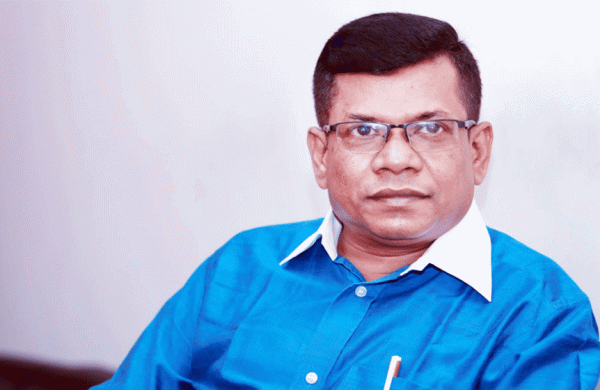
—Mostofa Kamal—
The country’s business community finds itself in a situation akin to clutching at straws to survive after falling into a pit. Any small sign of reassurance sparks hope. They look ahead with cautious optimism, dreaming of survival and sensing faint signals that the prolonged drought in business and investment may finally be nearing an end.
Against this backdrop, Bangladesh Bank Governor’s initiative to offer policy support to businesses—after nearly a year and a half—has come as major news for entrepreneurs. After a long time, it has generated visible excitement within the business community. They hope the measures will allow long-term loan rescheduling, restructuring, grace periods and partial write-offs with relatively low down payments—support they see as more valuable than a few drops of water in a desert.
If effectively implemented, the policy support could ease the pressure of defaulted loans and provide genuinely distressed borrowers with a chance to recover, business leaders believe.
High interest rates, stagnant investment, declining consumer demand, rising unemployment, reduced raw material imports and the energy crisis have not only pushed business and investment into a deep slump but have dragged the entire economy down with them. In such circumstances, survival has become the primary objective for investors, as they wait patiently for stability to return.
They firmly believe that political, economic, diplomatic and social stability is impossible without an elected democratic government. With that belief, they have endured the uncertainty, hoping that the formation of an elected government after the upcoming national parliamentary election next month will lift the prevailing gloom. Yet, even in their struggle to survive, business operating costs have risen by nearly 35 percent over the past year, while people’s purchasing power has not increased proportionately. As a result, sales have dropped by 20 to 30 percent.
Beyond political uncertainty, law and order challenges, energy shortages and high inflation, businesses are burdened by deep-rooted structural problems in the private sector. At present, their foremost expectation is a free, fair and credible election.
Rising default loans, liquidity shortages and weak governance in the banking sector have compounded the difficulties faced by businesses. High interest rates and tight credit policies have significantly raised investment costs—a reality also highlighted in the Planning Commission’s General Economics Division (GED) report titled Bangladesh State of the Economy. This suggests the government is well aware of the situation. Despite goodwill and interim reform measures, it has failed to provide the long-term policy certainty required for sustained investment. Bank loan interest rates of 14 to 16 percent have remained a “thorn in the throat” for investors.
Following recent political changes, reports of extortion under new guises and growing labour unrest in several areas have added to business anxiety. On one hand, high interest rates have sharply increased loan repayment burdens; on the other, banks, citing liquidity constraints, have shown reluctance to extend fresh credit.
Access to bank loans has become increasingly difficult not only for large entrepreneurs but also for cottage, micro, small and medium enterprises (CMSMEs). Many are struggling to meet loan instalments on time. Nearly 7.8 million CMSMEs contribute about one-quarter of GDP and employ around 40 percent of the country’s workforce. Political uncertainty, law and order issues and administrative instability have emerged as major barriers to investment.
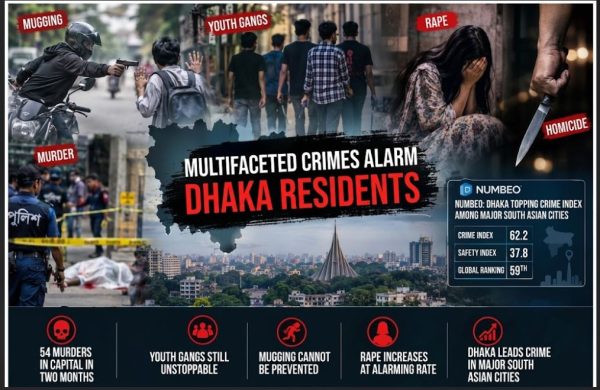
Recent incidents of violence and attacks in different parts of the country have raised serious concerns over public safety, severely undermining the investment climate. These developments have instilled deep fear among businesspeople, turning law and order into a major “boil” within the investment environment. Trust is the cornerstone of business and investment—and that trust has been badly shattered. Restoring confidence is now a critical task.
Broadly speaking, the three biggest obstacles facing businesses today are the law and order situation, instability in the banking sector and the energy crisis. Beyond these lie challenges related to logistics, corruption within the NBR, tax and VAT complications and long-standing infrastructure issues. Despite efforts, the current government has been unable to deliver tangible results. Business leaders believe a newly elected government will be better positioned to do so.
Inflation-driven erosion of purchasing power has directly disrupted factory production chains. On one hand, unsold inventories are piling up; on the other, severe gas and electricity shortages have forced factories to operate at less than half their capacity. Many industrialists have reduced production shifts, while some have temporarily shut down units after failing to cover production costs. Numerous garment factories have already closed, with many more on the brink—inflicting deep pain across the industrial sector.
Bangladesh Bank’s policy support may offer some relief, while the restoration of political stability through a smooth transition to democratic governance after the election could revitalise bilateral and international economic relations. An elected government would have the space to initiate private sector restructuring, easing the confidence deficit among stakeholders and helping the broader economy regain momentum.
A stable democratic government encourages dialogue and provides clarity on long-term policies—key factors in boosting investor confidence. Under the current system, businesspeople have little opportunity to voice their concerns or share ideas; instead, they are often ignored or portrayed as villains. Business leaders and their associations strongly believe that 2026 will mark a “turnaround year.” Foreign investors, they say, will not need to be courted—they will come on their own, shedding their “wait and watch” stance. Stalled projects will move forward.
A free and credible election would significantly boost international buyers’ confidence and help dispel the prevailing fear of mob violence—an anxiety affecting everyone from large investors to street vendors and even beggars. Overcoming this situation would lead to job creation and faster GDP growth. Provided there is no major global shock, lower energy and food prices, coupled with resilient global supply chains, could further support growth.
Signs are already emerging: declining global food and energy prices, gradual domestic economic stabilisation, easing inflationary pressures, and some relief in foreign transactions and foreign exchange reserves. The government has managed to halt the downward trend in reserves—offering a glimmer of hope amid continued uncertainty.
——————————————————————–
Writer: Journalist and Columnist; Deputy Head of News, Banglavision




Editor & Publisher: Golam Mostafa Jibon
News & Commercial Office:
2 R. K Mission Road, Dhaka & Railgate, Sirajganj.
Hotline: 01715-319996, 01558-314179
E-mail : editor.thedailysky@gmail.com
news.thedailysky@gmail.com