

Expelled by Jamaat, Satkhira-4 MP now faces Article 70 test
- Update Time : Wednesday, July 22, 2026
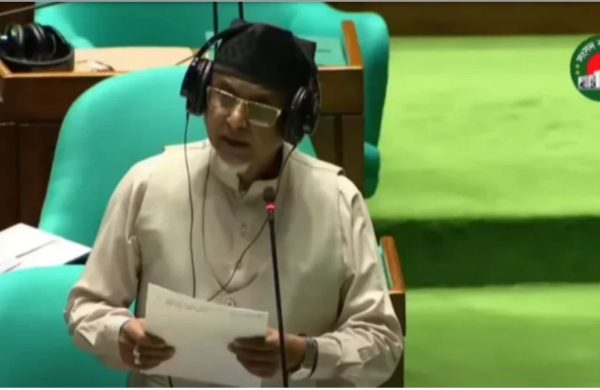
The decision to inform the EC has raised Article 70 questions over the MP’s fate
TDS Desk:
Bangladesh Jamaat-e-Islami on Wednesday expelled Satkhira-4 lawmaker Gazi Nazrul Islam over what it described as “moral misconduct,” triggering a constitutional process that could ultimately determine whether he is allowed to remain a member of the National Parliament.
The party’s decision to immediately inform the Election Commission (EC) shifts the controversy beyond internal disciplinary action and into a constitutional question under Article 70, reviving debate over what happens when an MP elected on a party ticket is expelled from that party.
The decision was taken at an emergency meeting of Jamaat’s Central Executive Council at the official residence of the opposition leader, chaired by party chief Dr Shafiqur Rahman.
In a statement issued after the meeting, Jamaat said an internal organizational inquiry had established allegations of “moral misconduct” against Nazrul Islam and decided to expel him under Article 62 of the party constitution.
It also announced that the Election Commission would be notified immediately.
The notification is expected to initiate the next constitutional stage concerning the MP’s parliamentary status.
Article 70 under fresh scrutiny
Whether Nazrul Islam ultimately loses his parliamentary seat is likely to depend on how Article 70 of the Constitution is interpreted by the Election Commission and other constitutional authorities.
Article 70 provides that an MP elected as the nominee of a political party vacates the seat if he resigns from that party or votes against it in Parliament.
The Constitution, however, does not explicitly state whether expulsion by the party automatically has the same effect.
Supreme Court lawyer Manzil Morshed told Dhaka Tribune that judicial interpretation has already addressed that question.
“Although Article 70 does not expressly mention expulsion, the Supreme Court settled the issue through a landmark judgment in the 1980s,” he said.
“The court held that when an elected representative loses membership of the political party that nominated him, the constitutional process begins and the Election Commission becomes the competent authority to determine the matter.”
According to Morshed, once Jamaat formally informs the Election Commission, the Commission will examine the issue in accordance with constitutional provisions before communicating its decision to the Speaker.
Latif Siddique precedent, but not a final answer
The development has revived comparisons with former Awami League minister Abdul Latif Siddique, who was expelled from the ruling party in 2014 following controversial remarks.
After his expulsion, the Awami League requested cancellation of his parliamentary membership, arguing that he could no longer retain the seat after losing party membership.
The Speaker subsequently referred the matter to the Election Commission.
Latif Siddique, however, argued that Article 70 only applies when an MP voluntarily resigns from the party or votes against it, and that expulsion alone is not mentioned as a constitutional ground for disqualification.
Before the Election Commission reached a final determination, Latif Siddique resigned from Parliament in September 2015, leaving the constitutional question unresolved.
Former Election Commissioner M Sakhawat Hossain later said that expulsion of an MP elected under a party’s nomination brings Article 70 into operation and requires the Election Commission to determine the MP’s constitutional status.
Yet parliamentary history also records a different outcome.
During the Eighth Parliament, BNP MP Abu Hena retained his parliamentary membership despite being expelled from the party after then Speaker Jamir Uddin Sircar ruled that expulsion alone did not terminate his seat.
Those differing precedents mean Nazrul Islam’s case could become one of the most closely watched constitutional tests involving Article 70 in recent years.
Jamaat’s toughest disciplinary decision
The controversy surrounding Nazrul Islam began after videos showing him in a private setting with a young woman circulated widely on social media.
The MP maintained that the woman was his legally married second wife and alleged that the footage had been secretly recorded and released as part of an extortion attempt and a politically motivated conspiracy.
The explanation, however, failed to stem public criticism as questions emerged over the timeline of the claimed marriage, documents circulating online and broader ethical concerns surrounding the relationship.
Jamaat subsequently launched its own internal investigation.
Wednesday’s decision represents one of the strongest disciplinary actions taken by the party since its return to parliamentary politics and reflects an effort to demonstrate organizational accountability amid mounting public pressure.
Jamaat’s decision itself does not automatically remove Nazrul Islam from Parliament.
The next step will be the party’s formal notification to the Election Commission.
The Commission, together with constitutional procedures involving the Speaker of the National Parliament, will determine whether the expulsion also results in the loss of Nazrul Islam’s parliamentary seat.







Editor & Publisher: Golam Mostafa Jibon
News & Commercial Office:
2 R. K Mission Road, Dhaka & Railgate, Sirajganj.
Hotline: 01715-319996, 01558-314179
E-mail : editor.thedailysky@gmail.com
news.thedailysky@gmail.com