

Speakers stress need for special policy to rehabilitate displaced people
- Update Time : Tuesday, September 8, 2026
Staff Correspondent, Khulna
Speakers at a discussion session on Tuesday (Sept 8) said south-western part of Bangladesh is one of the disaster prone zones of the globe owing to its geographical location as well as natural reasons. Due to climate change impact, the frequency and intensity of disasters are increasing, threaten lives and livelihood. A large number of people in the region are becoming poor and even ultra poor due to disaster and climate change effect year on year.
They opined that the issue of climate-induced displaced people deserves special policy options at regional, national and international level and support to ensure their relocation and rehabilitation.
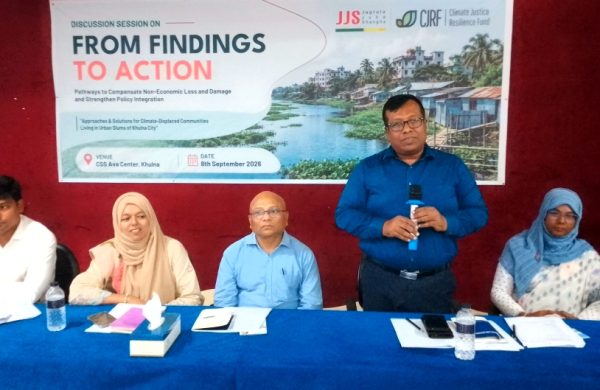
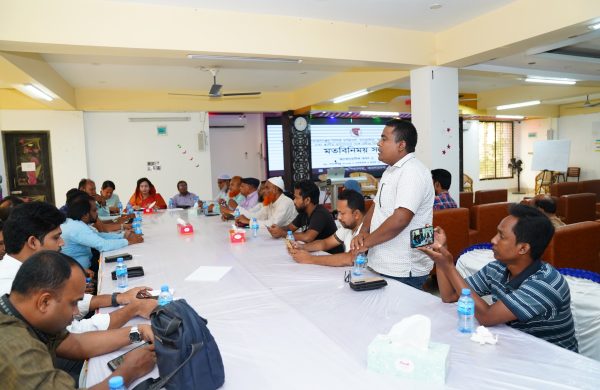
Jagrata Juba Shangha (JJS) arranged the discussion at CSS Ava Center under Sadar thana in Khulna city with the title “From findings to action: Pathways to compensate non-economic loss and damage and strengthen policy integration.”
Additional Divisional Commissioner (general) of Khulna Abu Syed Md Monjur Alam addressed the discussion as chief guest, while Executive Director of JJS ATM Zakir Hossain presided over the function.
Associate Professor of Institute of Disaster Management of KUET Dr Anjum Tasnuva, Professor Environmental Science Discipline of Khulna University (KU) Dr Salma Begum, Associate Professor of Development Studies Discipline of KU Dr Md Hasan Howdader, Deputy Director of Department of Women Affairs, Khulna Suraiya Siddiqa among others were present as special guests. Research and learning Coordinator of loss and damage special initiative project Md Sohel Rana conducted the discussion.
The speakers said that, the number of seasonal or temporarily migrated population will be increased from 10 percent to 20 percent in the country. Bangladesh hardly has ability to manage the climate-induced displaced population because of high density of population. They recommended an internal displacement policy for Bangladesh, which will help pursue relocations and rehabilitations policy measures at international and UN level.
Speakers said climate change had left an adverse impact on the coastal belt of the country where storms, cyclones, tidal surges, droughts, river erosion and water-logging are now regular phenomenon. They referred to several strong storms that have already battered the coastal area, like Sidr on November 15, 2007 and Aila on May 25, 2009.
Further threats arise from global climate change especially sea level rise along with its salinity, which have already caused death to many big trees of the largest mangrove forest Sundarbans, they added.








Editor & Publisher: Golam Mostafa Jibon
News & Commercial Office:
2 R. K Mission Road, Dhaka & Railgate, Sirajganj.
Hotline: 01715-319996, 01558-314179
E-mail : editor.thedailysky@gmail.com
news.thedailysky@gmail.com