

Muri: A timeless taste of Bangladesh
- Update Time : Sunday, August 16, 2026
– Atika Ulfat Shetu-

Atika Ulfat Shetu
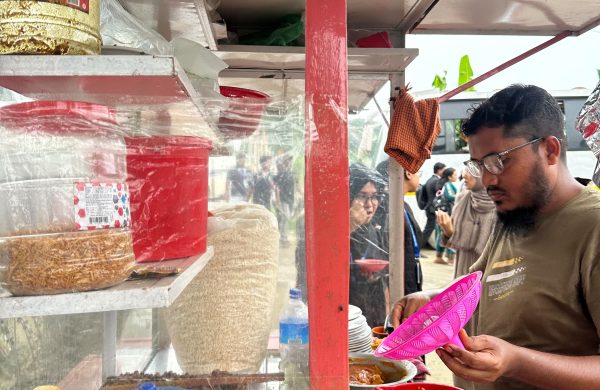
The first light of dawn has yet to be visible. The sky is still wrapped in a soft dark haze, but the fire in the clay stove is already flaming. Over the flames, a craftsman tirelessly stirs rice through hot sand in a giant iron pot. Sweat rolls down on his face, yet the rhythm of his hands never stops. Every steady stroke carries a craft, transforming ordinary rice into something that is far more than food. Then, almost like magic, the hard grains burst into light, white puffs-the timeless taste of Bengal, known simply as “Muri”/Puffed rice.
The crunch and taste of hand-roasted muri is deeply rooted in Bangladesh. In lively village markets, bustling city streets, Eid gatherings, and long journeys few foods have remained the same effortlessly across generations, social classes, and regions. Muri is light, affordable, easy to preserve, and quick to prepare, humble in appearance yet rich in traditional tales.
In many ways it can be served – mixed with mustard oil, onion, green chilies, and other spices, coriander, to make jhal muri, sometimes as sweet moa, with curd, semai, fruits or simply enjoyed with tea, these way it holds its own identity in every house in Bangladesh. From the very beginning, as a riverine nation repeatedly challenged by floods and cyclones, people have long depended on foods that are portable, non-perishable, and healthy. Muri became one of those dependable companions. However, during the holy month of Ramadan, handmade muri remains in high demand in Bangladesh. Health benefits strengthen its popularity among the other traditional dry foods in Bangladesh.
Nutritionist Dr Aysha Siddika said, Puffed rice is light and easy to digest and can be included in the diet chart, as it is rich in carbohydrates which provide instant energy for working hard.
The country’s most celebrated muri-producing regions are Pirojpur, Tangail, Cumilla, and Lakshmipur. In Lakshmipur a village called Barura, known as “MURI GRAM”(Village of Muri), where they don’t just roast muri, they enjoy it in a festive mood. Families have preserved the craft of hand-roasting muri for more than sixty years. From roadside vendors to modern cafés, muri continues to evolve. Educated professionals are embracing jhal muri businesses as a second source of income nowadays. One such person is Abul Kalam, an engineer who uses to sell jhal muri at Gazipur’s Chourasta. One-day I asked about his most memorable experience. His face lit up with a smile and said, “Once a foreign visitor stopped. After tasting my jhal muri, he became fascinated and asked how it is processed. I happily explained the mixing process step by step. Before leaving, he thanked me and said he would always remember this unique taste of Bangladesh.”
Again, when asked what makes him special apart from other vendors, for Kalam, “The price of muri may rise and fall, but its value in the hearts of Bangladeshis never fades. That’s why I write messages about our Bangladeshi Muri on my cart posters. People stop to read them, become curious, and come to my stall. After enjoying the jhal muri, many tell me that the words remind them of their childhood . At that moment, I feel I am not just selling a food item , I am helping preserve a part of Bangladesh’s cultural identity.”
His words reveal a larger truth: muri is one kind of Bangladeshi tradition and heritage. Today, rising prices of rice, fuel costs, and improved mechanized production have squeezed the profit of traditional hand-roasted muri producers, forcing them to sell to the wholesalers at minimal margins. Despite these challenges, the future holds promise. Growing demand for Bangladeshi muri in Europe, North America, and the Middle East, Saudi Arabia, has broadened opportunities for exporting careers. Statistics show that about 2,000 commercial mills have been established in the country, with an annual turnover of about 6 billion taka.
Across the world, countries proudly exhibit their iconic minimal items of culture that hold their history. Like-Japan has sushi, Italy has pasta, and Mexico has tortillas. Bangladeshi puffed rice has earned worldwide recognition successfully. While some traditions gradually fade away due to modernism, muri persists not through grand structures or museum exhibitions, but through everyday hands, well-known kitchens, street vendors, and generating foreign currency.
The writer is a student of Uttara University, Department of English.











Editor & Publisher: Golam Mostafa Jibon
News & Commercial Office:
2 R. K Mission Road, Dhaka & Railgate, Sirajganj.
Hotline: 01715-319996, 01558-314179
E-mail : editor.thedailysky@gmail.com
news.thedailysky@gmail.com