

Political parties’ education pledges show little innovation
- Update Time : Tuesday, January 27, 2026

TDS Desk:
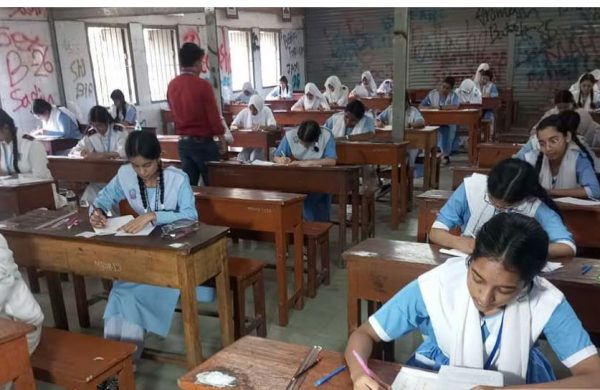
A deep crisis in Bangladesh’s education system, marked by multiple parallel systems starting from the primary level, a shortage of skilled teachers, falling standards, and frequent curriculum changes, is causing widespread concern. The problems extend to high dropout rates in secondary schools and a higher education sector misaligned with labour market needs, producing large numbers of unemployed graduates. The sharp erosion in educational standards during the ousted Awami League’s fifteen–year tenure has fuelled serious concerns for the future of young people and the development of a skilled workforce.
With the thirteenth national parliamentary election approaching, most political parties have already outlined plans and pledges for the education sector, though their formal manifestos have yet to be released. Educationists say the current promises show little innovation and overlook many core problems. They believe a clearer picture will emerge once full manifestos are published. These experts argue that only a genuine commitment from political parties, backed by new and timely plans, can pull the sector out of the deep crisis it entered during the past decade and a half of Awami League rule.
Article 17 of Bangladesh’s 1972 Constitution directs the state to take effective measures to establish a uniform, mass–oriented and universal education system, and to provide free and compulsory education to a level set by the law. Education itself, however, is not recognised as a fundamental right. The clause sits in Part II of the constitution which sets out fundamental principles of state policy and is not enforceable in court. Educationists argue this remains a major barrier to ensuring the same standard of education for all.
The education ministry has recently formed a ten–member advisory committee, led by BRAC University Emeritus Professor Manzoor Ahmed, to improve the quality of secondary education. He earlier chaired a nine–member advisory committee on reforming primary and non–formal education. Professor Ahmed told journalists, “The most fundamental problem in the country’s education sector is that the state hasn’t clearly accepted its responsibility. There’s a compulsory education law for primary education, which sets out the duties of guardians and penalties for non–compliance. But if the state doesn’t ensure the necessary schools, teachers, and infrastructure, the law doesn’t make clear what responsibility it bears. The Constitution also doesn’t declare education a right; it’s only a principle of state policy, which is not justiciable. The promises made by political parties so far ahead of the thirteenth parliamentary election don’t mention this issue. Even the July charter for constitutional amendment contains no reference to education.”
The primary education level in Bangladesh has the highest number of parallel systems. According to the Annual Primary School Statistics 2024, there are eleven distinct types of primary schools in the country. These institutions vary widely in curriculum, teaching methods, facilities and costs. Educationists argue this disparity exposes children to discrimination from their earliest years.
Among political parties, the Bangladesh Nationalist Party (BNP) has said in its 31–point outline for structural reforms that it will prioritise a “uniform standard of education” and “instruction in vernacular”. While the National Citizen Party (NCP) made no specific reference to this in its 24–point manifesto for a “new Bangladesh”, the party’s education secretary said it would work to ensure equity in education, including by integrating certain core subjects across all streams. No separate plans for primary education was mentioned by the Bangladesh Jamaat–e–Islami in its policy summit on January 20.
“BNP is giving the highest priority to education,” former BNP education minister ANM Ehsanul Hoque Milon told journalists. “If we form the government, we will ensure equality across all streams of education. We will guarantee that students from all streams gain proficiency in core subjects such as Bangla, English, Mathematics and Science, and that they receive equal opportunities everywhere, from higher education to the workplace. Currently, students from some streams are neglected. We will end this discrimination.”
Bangladesh is among the 193 UN member states that unanimously adopted the Sustainable Development Goals (SDGs) in 2015. The first sub–component of SDG Goal 4 stipulates that by 2030, all girls and boys must complete free, equitable, and quality primary and secondary education. However, Bangladesh trails South Asia and ranks among the weakest globally in providing free education. More than 50 percent of primary students and over 92 percent of secondary students in the country currently study in private institutions. Dropout rates are particularly high at secondary level; according to the Multiple Indicator Cluster Survey 2025, about 56.1 percent of students do not complete grade ten. Stakeholders cite high costs as a primary driver of this attrition.
The ousted Awami League, in its 2008 election manifesto, pledged to gradually introduce free education up to undergraduate level. It did not deliver on this promise during its fifteen years in power. The BNP’s 31–point agenda and Bangladesh Jamaat–e–Islami’s policy summit made no clear reference to resolving the issue. The NCP’s 24–point manifesto says MPO–listed educational institutions will be nationalised in phases. Bangladesh Jamaat–e–Islami, in its 2008 manifesto, had pledged free education up to HSC level.
An inadequate budget is among the main challenges facing the country’s education sector. UNESCO recommends allocating 6 percent of GDP to ensure quality education, but Bangladesh allocates less than 2 percent. The BNP has pledged in its 31–point agenda to raise education spending to 5 percent of the GDP. Neither Bangladesh Jamaat–e–Islami nor the NCP has so far addressed the issue.
On education budget, Dr Fahmida Khatun, executive director of the Centre for Policy Dialogue (CPD), said, “There is no alternative to increasing allocations to ensure quality education. But the budget is already in deficit, so there must be a clear plan for how any increase will be funded. Simply raising allocations is also not enough; proper use of the money is critical. A large share of education spending still goes on infrastructure, with little effective effort to improve quality. Ministries also often fail to spend allocated funds because of weak planning. Any allocation promised by political parties must therefore spell out funding sources, spending methods, and safeguards for financial transparency. Otherwise, questions will remain over implementation.”
Other core problems include falling educational standards and a shortage of skilled teachers. Comparisons of national student assessment reports at primary and secondary levels show a steady decline in competency as grades progress. Another gap is the absence of a reliable system for measuring Bangladeshi students’ skills against international benchmarks. The World Bank’s Human Capital Index offers a recent snapshot of standards up to the secondary level against global norms. It shows that what a Bangladeshi student learns after 10 years and two months of schooling, by grade eleven, is equivalent to just six years of learning, or sixth–grade competency, by international standards. A shortage of qualified teachers persists across all levels of the education system. The BNP’s 31 points, the policy positions announced by Jamaat–e–Islami, and the NCP’s 24–point agenda make no specific reference to addressing this problem.
Frequent curriculum changes present another major challenge for students. No education policy has ever been fully implemented. Political parties have yet to address these issues with any clarity.
During the ousted Awami League’s tenure, initiatives were taken to establish universities and medical colleges in every district. Many of these new institutions now face acute shortages of teachers, infrastructure, laboratories, and research equipment. The academic quality of these institutions also faces serious questions. No Bangladeshi university appeared in the top 500 of the Times Higher Education World University Rankings 2026 or the QS World University Rankings 2026. International assessments have repeatedly pointed to a skills gap among graduates. The QS Future Skills Index 2025 found that Bangladesh lags well behind in producing the skilled human resource global employers seek when recruiting graduates.
“We have plans to redesign the education system to make learning enjoyable,” Mahdi Amin, spokesperson for the BNP’s election steering committee and an adviser to Chairman Tarique Rahman, told journalists. “Alongside Bangla and English, we will teach a third language to expand access to the international job market. We will also give special priority to technical education to curb unemployment.”
Some education stakeholders argue that the drive to establish universities in every district has deepened the crisis in higher education. A government–formed task force on economic strategy in the post–uprising period has recommended merging universities to reduce their number. Task force members said consolidation would allow more efficient use of a constrained education budget and help improve international rankings.
In its 31–point agenda, the BNP says it will prioritise knowledge–based higher education and place special emphasis on research. The party’s 2018 manifesto made similar commitments on higher education and research. The NCP’s 24–point agenda includes a special action plan to build a strong foundation in science, mathematics, engineering and medical education. It also pledges to develop work–oriented vocational, nursing and skills training to international standards to create sustainable employment for all citizens. Jamaat has argued for expanding the number of universities and medical colleges. At its January 20 policy summit, it proposed merging Eden, Badrunnesa, and Home Economics College to form the world’s largest women’s university, and upgrading large colleges under the National University to full universities. Its 2008 manifesto had also promised a women’s university.
Bangladesh also trails in providing competitive pay and benefits for teachers. Reviews of recruitment notices from education ministries and governments worldwide show that salaries and allowances for Bangladeshi teachers are lower than in most countries, and the lowest in South Asia. The BNP’s 31 points and Jamaat’s policy summit do not address this issue. The NCP, in the tenth point of its 24–point agenda, says it will introduce a separate and competitive pay structure in line with global standards, and ensure teachers’ participation in shaping state policy and measures.
The previous government made a similar pledge on teachers’ pay in its 2008 election manifesto but failed to implement it.
The BNP’s 31–point agenda says educated but unemployed youth will receive an unemployment allowance for up to one year or until they find employment. It also pledges to adopt multiple pragmatic programmes to cut unemployment and take concrete steps to harness “demographic dividends” by upgrading skills of the youth. Jamaat said at its policy summit that 500,000 graduates would receive an interest–free loan, or Qard al–Hasanah, of up to BDT 10,000 a month for up to two years after graduation or until they are employed. It also proposes interest–free education loans of BDT 10,000 a month for 100,000 students on merit and need, and interest–free loans each year for 100 students to study at the world’s top universities. In its 2018 manifesto, the BNP had pledged low–interest loans for higher education, a scholarship fund for advanced degrees at leading foreign universities, and an unemployment allowance. Ahead of the thirteenth parliamentary election, the BNP has also signalled plans for student loans for those facing financial hardship while studying abroad.
Asked about its plans for the education system, Foysal Mahmud Shanto, secretary of the NCP’s Education and Research Cell, told journalists: “If we win the election, we will prioritise education. We will ensure equity across all streams, preserving their distinct features while making some core subjects compulsory across them, and reducing discrimination between streams. Alongside Bangla and English, we will take steps to teach one or more additional languages to improve access to the global job market. We also want to stress employment–oriented education. To attract talented candidates to teaching, we are aiming for a separate pay structure for teachers and a unified examination system to make recruitment transparent and free of corruption. Even if we don’t win, we will discuss these plans with whichever party forms the government. We want education policy to be inclusive, shaped through broad participation rather than a single party’s thinking. Otherwise, problems emerge, including frequent curriculum changes. We will set this out in detail in our manifesto.”
Asked about its plans for the education sector, Ahsanul Mahboob Zubair, assistant secretary general and head of the central publicity and media department of Bangladesh Jamaat–e–Islami, told journalists: “We have already outlined some points at the policy summit. More detailed plans on education will be included in the manifesto.”



Editor & Publisher: Golam Mostafa Jibon
News & Commercial Office:
2 R. K Mission Road, Dhaka & Railgate, Sirajganj.
Hotline: 01715-319996, 01558-314179
E-mail : editor.thedailysky@gmail.com
news.thedailysky@gmail.com