

Rising input prices threaten Boro acreage and yields
- Update Time : Saturday, February 28, 2026
TDS Desk:
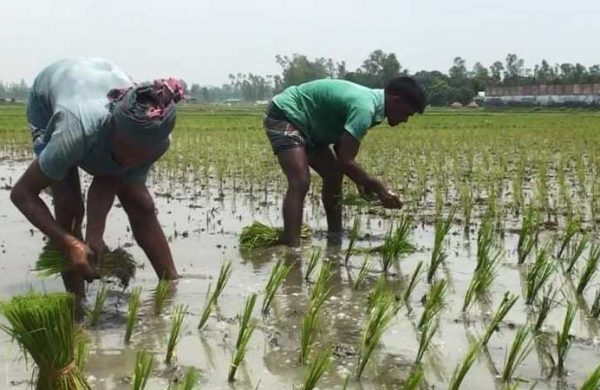
Farmers across Bangladesh have begun planting Boro, with work underway in several regions. Fertiliser is critical for this irrigation-dependent crop. The government has already fixed fertiliser prices to ease supply. Yet growers say they cannot buy at those rates, driving up their costs. After paying for key inputs such as pesticides and irrigation, they see little prospect of profit. Many are even reducing Boro cultivation and cutting acreage.
In Jashore Sadar upazila’s Dhopakhola, farmer Mostafa has planted Boro on five bighas (each bigha is equivalent to 1,338 square meters). The seedlings, transplanted about a month ago, have turned from red to green. The fields now need fertiliser for panicles to form. In light drizzle on Tuesday morning, Mostafa spread urea, TSP and zinc.
“Many here have reduced their Boro planting because the returns aren’t good,” he said. “Others have stopped cultivating altogether.” He buys urea at BDT 1,460 a bag and DAP at BDT 1,250. After paying for fertiliser, irrigation, pesticides and labour, he said there is little profit left.
Nearby, Channu Mia was weeding his plot. “Every syndicate in this country is lined up against us farmers,” he said. “We never get a fair price for what we grow. The moment our produce passes through other hands, the price doubles.”
He cited the same gap: DAP that should cost BDT 1,050 a bag sells for BDT 1,250, while urea fixed by the government at BDT 1,250 is sold for BDT 1,450. “In peak season we have to use fertiliser, so we’re forced to pay over the odds,” he said.
Several larger growers said dealers charge BDT 1,450 for a 50 kg bag of urea and BDT 1,250 for DAP — reflecting BDT 29 and BDT 25 per kg respectively, against official rates of BDT 27 and BDT 21. Prices are higher still when bought from sub-dealers or local traders.
Mosharraf Hossain, deputy director of the Jashore Department of Agricultural Extension, said the government is supplying fertiliser at “subsidised rates”. He denied any shortage and warned, “Legal action will be taken if anyone is found manipulating the market or running a syndicate.
A similar pattern has emerged in Sirajganj. The district has set a Boro cultivation target of 141,750 hectares this year, of which about 85,000 hectares have been transplanted. Growers allege dealers are hoarding stocks at the start of the season, creating an artificial shortage. Farmers are therefore paying higher prices, raising doubts about the crop’s viability. The local administration says it has acted against the accused dealers.
Department data show the Boro season demands at least 56,370 tonnes of urea, 19,276 tonnes of TSP, 17,982 tonnes of MOP and 29,243 tonnes of DAP. Authorities have allocated supplies to 148 dealers under the Bangladesh Chemical Industries Corporation (BCIC) and 206 under the Bangladesh Agricultural Development Corporation (BADC).
Traders, however, are accused of hoarding fertiliser to engineer scarcity and sell at higher prices. The local administration says it has carried out raids, seized stock and fined offenders. Farmers say some dealers are still stockpiling and operating as a syndicate to drive up prices. They warn hoarding will raise cultivation costs and, if it delays supply, cut yields.
In Nishchintapur union in Kazipur upazila, farmer Porag Ali said supplies were scarce. “We need fertiliser badly when the peak season starts. Dealers make all sorts of excuses, especially for non-urea types. They often say stocks are low or finished. But if a premium is paid, the fertiliser appears. The government should take this seriously, otherwise farmers like us will suffer.”
Wahedul Islam, president of the Sirajganj unit of the Bangladesh Fertiliser Association, said members were supplying allocated stocks at official prices as instructed. “Still, we receive reports of irregularities against some dealers — selling above the fixed rate, stockpiling and so on. We have asked the district administration to act. We are on alert. If any dealer is found breaking the rules, the association will act.”
QM Manzur-i-Mowla, deputy director of the Sirajganj DAE, told journalists, “Complaints against some dealers are coming in. We’re monitoring the situation. We have taken action against several individuals. The district has ample stocks. Anyone who sells above the government rate or hoards supplies will face action.”
The district commissioner and chairman of the district fertiliser and seed monitoring committee, Md Aminul Islam, said farmers have the right to easy fertiliser access at fair prices. “If any irregularity involves these supplies, dealers will be fined and could lose their licences. Clear instructions have been issued.”






Editor & Publisher: Golam Mostafa Jibon
News & Commercial Office:
Railgate, Sirajganj & 2 R. K Mission Road, Dhaka.
Hotline: 01715-319996, 01558-314179
E-mail : [email protected]