

When a schoolbag becomes a burden for a kid
- Update Time : Wednesday, September 30, 2026
By Lamia Akter Tonni

– The Author
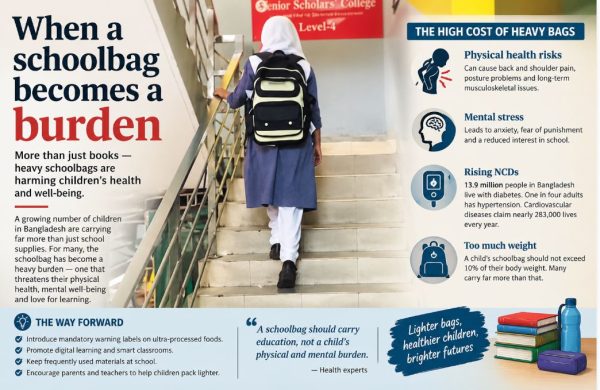
A schoolbag is supposed to carry books, notebooks and the tools of learning, but when it becomes too heavy for a child to carry comfortably, it turns into something far more than a piece of fabric—it can become a burden affecting a child’s physical well-being, mental comfort and even attitude towards school.
Every morning, a familiar scene unfolds across Bangladesh. Young schoolchildren walk or rush towards their schools with oversized bags hanging from their shoulders. Some bend forward under the weight; others slow down or stop occasionally to rest.
What may appear to be an ordinary part of school life can have consequences that deserve greater attention.
WHEN BOOKS BECOME A PHYSICAL BURDEN
Students are often required to carry several textbooks, exercise books and other learning materials to school every day. Separate books and notebooks for different subjects are joined by supplementary books, homework copies, drawing materials, water bottles and lunch boxes.
For children between the ages of five and 10, whose bones and muscles are still developing, carrying excessive weight regularly can cause physical discomfort and may contribute to musculoskeletal problems.
Health professionals generally advise that a schoolbag should not exceed about 10 percent of a child’s body weight. Yet many students carry considerably more than that.
Some children complain of back and shoulder pain at an age when such problems would traditionally be associated more with adults. An otherwise routine journey to school can therefore become physically exhausting before the school day has even begun.
The problem does not end when the school bell rings. The same bag remains on the child’s shoulders while moving between classrooms, climbing stairs and travelling home after hours of study.
A student named Nuha recently described the experience simply: “It would be much easier for us if the bag were lighter.”
The statement may sound ordinary, but it reflects a daily reality shared by many schoolchildren.
THE HIDDEN MENTAL PRESSURE
The weight of a schoolbag is not measured only in kilograms.
Children may also feel pressure from having to remember numerous books and notebooks each day. Forgetting a particular book can mean being reprimanded by a teacher, creating additional anxiety before the school day begins.
For young children, education should ideally be associated with curiosity, creativity and enjoyment. When the journey to school itself becomes physically uncomfortable and mentally stressful, their enthusiasm for learning can gradually diminish.
Parents, too, are noticing the problem. One parent said her child had experienced shoulder and back pain and that she believed the excessive weight of the schoolbag was contributing to the discomfort.
Thus, the issue extends beyond the classroom. It has become part of children’s daily routine—from home to school and back again.
A PARADOX IN THE EDUCATION SYSTEM
There is also an apparent paradox in the way academic materials are distributed across different stages of education.
At the primary level, children often have to deal with a large number of books and learning materials. At the secondary level, the burden may gradually decrease. By college, students generally carry fewer books, while university students can often manage with lecture sheets, digital materials or selected texts.
In other words, the physical burden tends to decrease as students grow older and become physically stronger.
Ideally, the opposite should happen: younger children, who are physically less capable of carrying heavy loads, should have lighter schoolbags and simpler arrangements for learning materials.
Education should never become a physical burden for a child.
TECHNOLOGY COULD OFFER PART OF THE SOLUTION
Technology could play a role in addressing the problem.
Digital textbooks, online learning materials and smart classrooms are already being introduced in many parts of the world. Where appropriate, tablets or digital notes could reduce the number of physical books children need to carry.
Schools could also consider keeping frequently used educational materials on campus instead of requiring students to transport them every day.
Teachers and school authorities can help children organise their bags and identify only the books and materials needed for a particular day’s lessons. Parents can also encourage children to check their schedules before leaving home rather than carrying every book “just in case”.
Such relatively simple measures could make a meaningful difference.
A SMALL CHANGE WITH A BIGGER MEANING
A schoolbag may look small when it is empty. Once filled with books, notebooks, stationery, a water bottle and other necessities, however, it can become surprisingly heavy. In some cases, the weight can approach eight kilograms—an amount that can be difficult for a young child to carry repeatedly.
Reducing that burden may seem like a minor issue compared with the larger challenges facing the education sector. But for the child who carries the bag every morning, it can mean an easier journey, less physical discomfort and more energy left for learning.
The purpose of a schoolbag is simple: to carry the materials necessary for education.
It should never become a symbol of the physical and mental burden of education itself.
Childhood is meant to be a time of learning, discovery, movement and laughter. Ensuring that schoolbags remain manageable is a small but important step towards protecting that childhood.
And perhaps it is time to ask a simple question: How much weight should a child have to carry simply to go to school and learn?
The author Lamia Akter Tanni is a student of English Department at Uttara University









Editor & Publisher: Golam Mostafa Jibon
News & Commercial Office:
2 R. K Mission Road, Dhaka & Railgate, Sirajganj.
Hotline: 01715-319996, 01558-314179
E-mail : editor.thedailysky@gmail.com
news.thedailysky@gmail.com