

Why a regional supply network is essential for Energy Security
- Update Time : Wednesday, August 12, 2026
TDS Desk:
Bangladesh is currently grappling with a severe energy crisis. The shortage of natural gas has spilled far beyond the power and energy sectors, beginning to affect the broader economy. The shutdown of power generation plants has intensified load-shedding across the country. The shortages of gas and electricity are disrupting trade and commerce, industrial production, and even household activities. This situation has emerged primarily because electricity generation has fallen short of demand. According to the latest data from the Power Grid Company of Bangladesh (PGCB), at least 62 of the country’s 143 listed power plants are facing fuel shortages. Of these, 26 are gas-fired, 33 are liquid-fuel-based, and two are coal-fired power plants.
The ongoing conflict between the United States and Iran has triggered a serious global energy crisis. With the Strait of Hormuz effectively closed, oil prices have surged dramatically. This is because nearly one-fifth of the world’s energy trade passes through the Strait. Consequently, not only Bangladesh but many countries around the world are confronting energy shortages. Bangladesh was already under significant economic pressure due to the Russia-Ukraine war, particularly in the energy sector. The renewed conflict in the Middle East has further aggravated the crisis, creating an alarming situation for an import-dependent economy like Bangladesh.
According to the Bangladesh Petroleum Corporation (BPC), the country imports 95 per cent of its oil demand and 30 per cent of its gas demand. Diesel accounts for 63 per cent of Bangladesh’s total energy consumption. There was a time when almost all of the country’s diesel imports came from Kuwait. Over the past two decades, however, the sources of imports have changed significantly. Data from the National Board of Revenue (NBR) show that in the 2006-07 fiscal year, 91 per cent of the diesel imported by BPC originated from Kuwait, while India accounted for the remaining 9 per cent. That pattern has since changed considerably. Today, Bangladesh imports fuel from India, Singapore, Malaysia, China, the United Arab Emirates, Saudi Arabia, and several other countries. Current statistics indicate that 41 per cent of diesel imports come from Singapore, 24 per cent from Malaysia, and 15 per cent from India. Liquefied Petroleum Gas (LPG), meanwhile, is imported from the United States, Oman, the United Arab Emirates, and Iraq.
The interim government has signed an unequal trade agreement with the United States, compelling the current government to purchase fuel from the US at higher prices. Moreover, fuel shipments from the United States take between 15 and 20 days to reach Bangladesh. Naturally, the higher transportation costs have also contributed to rising fuel prices.
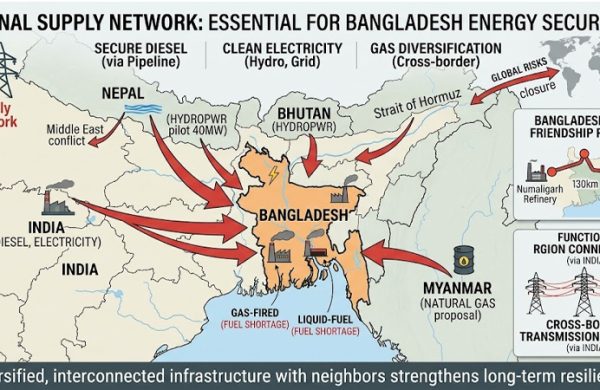
During the previous political administration, the Bangladesh-India Friendship Pipeline was constructed to facilitate diesel imports from India. Built with Indian financing, the approximately 130-kilometre pipeline became operational in December 2022. Through this pipeline, diesel is transported directly from the Numaligarh Refinery in Golaghat district of Assam to the Parbatipur depot in Dinajpur, Bangladesh. As a result, fuel reaches Bangladesh within just two days of being dispatched from the refinery, saving both time and costs.
Following the subsequent political transition, oil imports from India came to a halt during the tenure of the interim government after bilateral relations between Bangladesh and India experienced tensions. Since the current government assumed office, diesel imports from India resumed in March this year. The Bangladesh Petroleum Corporation has set a target of importing more than 100,000 tonnes of diesel during the current year. A substantial volume of fuel has already been delivered through the pipeline. More recently, Bangladesh’s Cabinet Committee on Government Purchase decided to procure a large quantity of refined petroleum products from India. Under the government-to-government (G2G) framework, it has recommended approving the import of refined fuel worth approximately BDT 168.8852 billion for the six-month period from July to December 2026.
In 2017, during the tenure of the then political administration, Bangladesh signed an agreement with India’s Adani Group to import electricity. At the time, opposition parties strongly criticised the deal. However, after assuming office, the BNP-led government retained the decision to import 1,400 megawatts of electricity from Adani. Even during the interim government’s strained relations with India, the agreement with Adani was not cancelled. Today, Adani supplies around 10 per cent of Bangladesh’s approximately 14,000 megawatts of electricity generation, playing a critical role in keeping the country’s power supply system operational. It has now become evident how important this agreement has been for Bangladesh.
Over the past several years, energy cooperation between India and Bangladesh has expanded significantly. Alongside diesel supplies, cross-border pipeline connectivity, and electricity trade, India’s role in supplying refined petroleum products has become increasingly important. According to energy experts, Bangladesh’s decision to procure fuel regularly from the Indian Oil Corporation Limited (IOCL) is significant not only from a commercial perspective but also as an important pillar of the strategic partnership between India and Bangladesh.
Bangladesh also has the opportunity to import electricity from Nepal and Bhutan through India’s transmission network. On a pilot basis, the country has already imported 40 megawatts of electricity from Nepal via the regional transmission grid. At the same time, Bangladesh has sought Myanmar’s cooperation to address its gas shortage, including a proposal to import natural gas through a cross-border pipeline.
Experts argue that Bangladesh must further diversify its sources of energy imports. Excessive dependence on any single region or supplier exposes the country’s energy security to significant risks. In an era marked by geopolitical instability, establishing a robust regional energy supply network with neighbouring countries – particularly India, Nepal, Bhutan, and Myanmar – is essential. Developing interconnected infrastructure for diesel, natural gas, and electricity grids among these countries would significantly strengthen Bangladesh’s long-term energy security and resilience.











Editor & Publisher: Golam Mostafa Jibon
News & Commercial Office:
2 R. K Mission Road, Dhaka & Railgate, Sirajganj.
Hotline: 01715-319996, 01558-314179
E-mail : editor.thedailysky@gmail.com
news.thedailysky@gmail.com