

Bloodshed in Congo, Bangladesh Army raises flag of peace
- Update Time : Thursday, June 11, 2026
Online Desk:
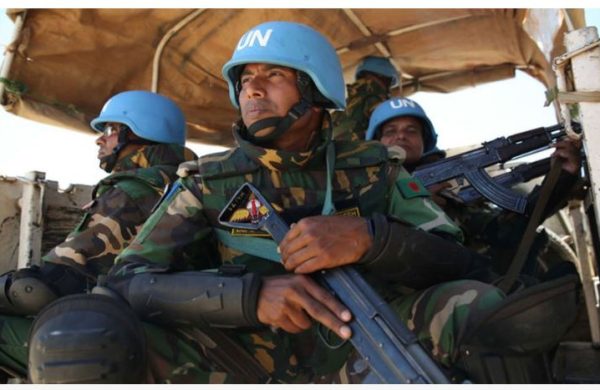
The Bangladesh Armed Forces have been playing one of the leading roles under the United Nations in restoring peace in conflict-ridden and war-torn regions around the world. Every year, 29 May is observed as the International Day of United Nations Peacekeepers. Although the mission began in 1948, Bangladesh joined it in 1988. Through professionalism, courage, and sacrifice in some of the world’s most dangerous conflict zones, including Congo, Mali, Sudan, and Somalia, Bangladesh has become one of the top contributors to UN peacekeeping operations.
In the mineral-rich African nation of the Democratic Republic of the Congo, the Bangladesh Army has fought bloody battles, overcome environmental and language barriers, and successfully conducted military operations in historically volatile areas to establish peace and protect civilians. On these issues, Brigadier General Mohammad Imdadul Haque, General Mahbub Hayder Khan, and Brigadier General Abu Musa Sharafuddin spoke with popular satellite television channel News24. Their real-life experiences highlight Bangladesh’s heroism in peacekeeping missions.
Question: Every year, 29 May is observed as the United Nations International Day of Peacekeepers. What is the significance of this day?
General Mahbub Hayder Khan: Although Peacekeepers Day has been observed worldwide since 1948, in Bangladesh we first began celebrating it jointly in 2007 with the local UN office and the Armed Forces. The significance of this day is that we spread the message of peace across the world. Many people think the military exists only to fight wars. We want to change that perception and demonstrate that weapons and ammunition can also be used to establish peace. Thanks to the contributions of our peacekeepers, peace has returned to many countries, allowing people to lead normal lives and move forward on the path of development.
Question: Bangladesh is now carrying the flag of peace across the world. When did Bangladesh’s journey in peacekeeping missions begin?
Brigadier General Abu Musa Sharafuddin: Bangladesh first participated in peacekeeping missions in 1987–88 as part of observer missions. Later, the UN’s main peacekeeping branch, the Department of Peacekeeping Operations (DPKO), invited Bangladesh to deploy full troop contingents because of the Bangladesh Army’s outstanding professionalism and reputation. Since then, the Bangladesh Army has been participating in some of the world’s most challenging missions, including those in Somalia, Sudan, and Congo. Through highly professional service, our forces have enhanced the country’s image on the global stage.
Question: We know that 174 Bangladeshi peacekeepers have sacrificed their lives for world peace. How would you assess this sacrifice?
Brigadier General Mohammad Imdadul Haque: The sacrifice of these 174 peacekeepers is both heartbreaking and a glorious chapter of heroism for our Armed Forces. Whenever conflict erupts in a war zone, we set aside concerns for our own lives to protect the honor of our country and the reputation of the military. This is the supreme sacrifice made by our soldiers. The stories behind these sacrifices deserve to be known by the people of Bangladesh.
Question: Why did the United Nations decide to deploy a mission in Congo, and how did Congo become trapped in such severe conflict and instability?
General Mahbub Hayder Khan: Congo is an unfortunate country that was previously known as Zaire. It is rich in valuable mineral resources such as gold, diamonds, cobalt, and coltan. Its land is so fertile that crops grow abundantly even without fertilizer. Such immense wealth attracted the greed of both external forces and domestic interest groups. Although the country gained independence in 1960 after nearly 250 years of colonial exploitation, ethnic divisions and internal conflicts continued. Following the horrific genocide in neighboring Rwanda in 1994, many armed rebel groups entered eastern Congo, further complicating the situation. After nearly three million people lost their lives in the violence, the United Nations decided in 1999, under the Lusaka Agreement, to deploy peacekeepers there.
Brigadier General Abu Musa Sharafuddin: Let me add something. Immediately after independence in 1960, the United Nations deployed peacekeepers in Congo for the first time due to widespread disorder, and the mission continued until 1964. When the situation improved somewhat, the mission was withdrawn. Following the 1999 agreement, the MONUC mission was launched, and since 2010 it has continued under the name MONUSCO. Bangladesh’s Armed Forces have been actively contributing to peace efforts in Congo since 2003.
Question: You worked under Chapter VII operations in Congo. What kind of operation was that?
Brigadier General Abu Musa Sharafuddin: In 2003, militias launched a sudden and devastating attack on a UN camp in Bunia, the capital of Congo’s eastern Ituri Province. When the situation spiraled out of control, the UN Security Council authorized Chapter VII. Under this mandate, peacekeepers were granted full authority not only to defend themselves but also to conduct direct offensive military operations and use force to protect civilians, UN personnel, and NGO workers. Very few missions in the world are granted such authority, and Congo is one of them. Sudan and Lebanon have also had missions operating under Chapter VII authority. Only three or four UN missions operate under this framework.
Question: Most viewers understand war through television screens or newspaper reports. How terrifying and complex is the reality of a battlefield?
Brigadier General Mohammad Imdadul Haque: The reality of a battlefield exists on a completely different dimension. When we were planning the Ituri Nongrendar Operation in Congo under Chapter VII authority, our objective was to destroy the main militia stronghold and drive the rebels out of a school and its surrounding area in Aveba. The operation targeted the elimination of militia control from that region and the restoration of security for the local population.
Question: Which countries’ forces were involved in your mission, and how did you coordinate with them?
General Mahbub Hayder Khan: Alongside Bangladesh, peacekeepers from more than 12 countries participated in the MONUC mission, including Pakistan, Nepal, Morocco, Uruguay, Guatemala, Indonesia, and India. The Indian Air Force deployed attack helicopters, while the Bangladesh Air Force provided utility helicopters. Our assigned area of responsibility was nearly the size of the whole of Bangladesh. Despite differences in language and culture among the participating countries, we conducted our military operations through excellent coordination across this vast and remote region.
Question: What responsibilities were assigned to Bangladesh Battalion-3?
Brigadier General Abu Musa Sharafuddin: Our primary responsibility was to ensure a completely secure environment for Congo’s upcoming general election. At the time, the country was experiencing extreme instability. To restore order, we carried out more than 3,000 operations of various scales. In addition, our key responsibilities included protecting important government installations, preventing civilian massacres, dismantling militia camps, providing escorts and security to UN agencies, and supporting reconstruction activities.
Question: When did your first major operation, Operation Boga, begin, and what was the experience like?
Brigadier General Abu Musa Sharafuddin: Just 15 days after assuming responsibility on 22 August 2005, we were ordered to launch Operation Boga. The Boga region was located 80 kilometers from our main camp, deep within dense forests and surrounded by high mountains. On 9 September, we set out amid heavy rain without the opportunity for prior intelligence gathering or ground reconnaissance. Alongside Bangladeshi troops, local army units and Senegalese and Moroccan forces participated in the mission. Although the journey was expected to take a single day, the poor road conditions prevented us from covering even half the distance in three days. We had to construct makeshift culverts from large logs to move 50 to 60 armored vehicles across difficult terrain. On the third day, the Indian Air Force informed us that about 200 militia fighters were waiting in ambush on a hilltop 15 kilometers ahead. During the advance, one armored personnel carrier carrying 10 soldiers slipped on the muddy road and plunged 50 feet into a ravine. Fortunately, we rescued everyone alive and without major injuries. Later, following an alternative plan, troops were deployed by helicopter and the operation was successfully completed.
Question: Apart from environmental challenges, there were language barriers as well. What difficulties did you face in gathering intelligence for military operations?
Brigadier General Abu Musa Sharafuddin: French and the local Swahili language were widely used in Congo. To gather information, we relied on trusted local interpreters. Our intelligence and patrol teams also built relationships with local communities to obtain information. We received intelligence from other UN agencies, such as the World Food Programme. However, the greatest challenge was that civilians, fearing retaliation from the rebels, were often reluctant to share information. Compared to our experience in the Chittagong Hill Tracts, intelligence gathering in Congo was far more complex and constrained.
Question: Why did the first two operations in the Che region fail, and how was Operation Ituri Explorer planned differently?
General Mahbub Hayder Khan: The Che region is located at the junction of the Congo, Rwanda, and Uganda borders and consists of extremely dense forests and mountainous terrain. Because of its remoteness, militias had turned it into their main training center and weapons depot. Securing Che was essential for ensuring a successful election. Two previous operations, conducted in December 2005 and February 2006 by forces from other countries, failed because of fierce rebel resistance. When we were assigned the mission in May, we studied the earlier failures and conducted extensive war-gaming exercises. Plans were developed to overcome language and communication barriers. While previous operations had attacked from only one direction, we launched a coordinated three-pronged assault through northern, central, and southern task forces, while positioning Congolese government forces at the forefront. This strategy successfully destroyed the enemy stronghold.
Question: What were the main challenges during the entire operation?
Brigadier General Mohammad Imdadul Haque: One of the biggest challenges was the multilingual environment. Personnel from eight to ten countries were involved in the joint force, and not everyone spoke English, including many of the Congolese soldiers working alongside us. Although interpreters were available, accurately conveying intentions during intense combat situations was often difficult. Differences in communication and signal equipment also significantly increased the complexity of the operation.
Question: What was the greatest achievement of the Bangladesh contingent in Congo?
Brigadier General Abu Musa Sharafuddin: Our greatest achievement was restoring peace to a blood-soaked region despite countless challenges. As a result, local people gained confidence and were able to participate in the first successful and peaceful election in Congo’s history. We also significantly restricted the movement and activities of rebel militias.
Question: Finally, based on your direct combat experience, what message would you like to share with the public?
General Mahbub Hayder Khan: This international mission greatly strengthened our confidence in the Bangladesh Army’s professional training and combat capabilities. The classical military strategy we used to liberate the Che region was unique in world military history. The lessons we learned from real battlefield conditions have been immensely valuable for us.
Source : News24




Editor & Publisher: Golam Mostafa Jibon
News & Commercial Office:
2 R. K Mission Road, Dhaka & Railgate, Sirajganj.
Hotline: 01715-319996, 01558-314179
E-mail : editor.thedailysky@gmail.com
news.thedailysky@gmail.com