

Rooppur Races to Join Global Nuclear Boom
- Update Time : Sunday, September 20, 2026
TDS Desk:
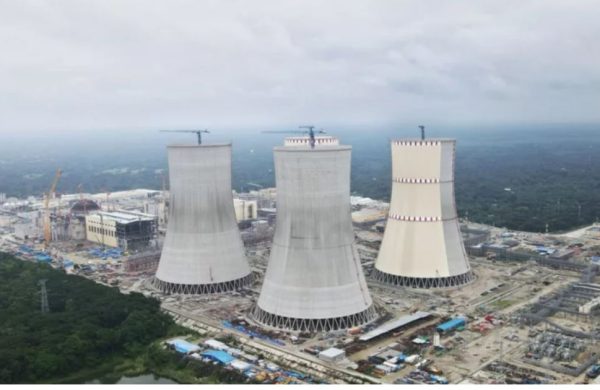
Amid an ongoing power shortage and heavy reliance on fuel imports, Bangladesh is racing to bring its first nuclear power plant online. The push comes as the global nuclear energy industry enters a new expansion phase, with the International Atomic Energy Agency (IAEA) projecting that worldwide nuclear capacity could more than triple by 2060.
The Bangladesh government is seeking IAEA support to expedite electricity generation from the Rooppur Nuclear Power Plant, where technical issues with two safety valves have delayed the commissioning of Unit 1.
Science and Technology Minister Faqir Mahbub Anam raised the issue with IAEA Director General Rafael Mariano Grossi in Vienna on September 17, while reiterating Bangladesh’s commitment to nuclear safety and security.
Two days earlier, Bangladesh and Russia’s state nuclear corporation, Rosatom, agreed to accelerate the remaining work at Rooppur to connect the plant to the national grid as quickly as possible while adhering strictly to international safety standards.
The latest push follows the government’s acknowledgment that faulty safety valves had halted Unit 1 from progressing to the next stage of commissioning. Russian experts are slated to assess the problem. Officials are considering whether to repair or replace the valves, or swap them with valves earmarked for Unit 2—depending on which solution is technically viable and faster to execute.While the government has not committed to a firm timeline for resolving the issue, Russian Ambassador to Bangladesh Alexander Khozin stated on September 16 that Rooppur is expected to supply 300 megawatts to the national grid next month. Nearly 4,000 Russian experts and engineers are currently working on-site to address the technical hurdles. However, meeting this target remains contingent on completing technical fixes, commissioning steps, and regulatory clearances.
Speaking on Sunday, Rooppur Project Director Dr. Md. Kabir Hossain confirmed that the expert team is actively working on the issue, but noted it is too early to specify when Unit 1 will begin feeding power into the national grid.
“The team is working to resolve the issues. Once this stage is completed, two or three additional phases of work remain. Only after those are cleared can we confirm when electricity will be supplied to the grid. This is the latest update I can share,” Hossain said.Despite the setback, recent developments mark a historic transition for Bangladesh’s largest power infrastructure project. Fuel loading for Rooppur Unit 1 began on April 28, 2026, officially transitioning the reactor into its commissioning phase and bringing Bangladesh closer to generating nuclear power for the first time.
Located in Pabna, the Rooppur plant features two Russian-built VVER-1200 reactors, each with a generating capacity of 1,200 MW, giving the facility a total planned capacity of 2,400 MW.Bangladesh’s integration of nuclear power coincides with a projected global expansion. According to the IAEA’s latest report, Energy, Electricity and Nuclear Power Estimates, global nuclear electricity generation could reach 696 gigawatts (GW) by 2060—nearly double its 2025 level. At the end of 2025, 413 nuclear reactors were operational worldwide, with a combined capacity of 377.1 GW.
The IAEA has extended its projection horizon to 2060 for the first time, reflecting renewed global interest in nuclear energy as nations navigate surging electricity demand, energy security risks, and the push for low-carbon power generation.
Much of this growth will be concentrated in Asia; under the IAEA’s high-growth scenario, nuclear capacity in Central and Eastern Asia is projected to surge from 114 GW in 2025 to 407 GW by 2060.
The IAEA also anticipates an expanding role for Small Modular Reactors (SMRs). While Rooppur relies on large-scale 1,200 MW units, the broader industry is rapidly pivoting toward SMRs, which the IAEA estimates could account for up to 28% of all new nuclear capacity added globally by 2060. For Bangladesh, while the immediate priority remains commissioning its two large reactors, the global shift toward SMR technology could influence future expansions of its nuclear energy portfolio.
Furthermore, much of the world’s existing nuclear fleet is aging, with approximately two-thirds of operational reactors having been in service for more than 30 years. The IAEA expects a significant portion of these units to be retired by 2060, creating a need for new nuclear installations to replace retiring capacity in addition to satisfying new demand. In 2025 alone, seven reactors were decommissioned, three new units were connected to grids globally, and construction began on 12 others.
First envisioned decades ago, Bangladesh’s nuclear ambitions gained tangible momentum in 2011 after signing a bilateral agreement with Russia to construct the twin VVER-1200 plant in Pabna. As the broader world prepares for a new nuclear era, Rooppur stands as Bangladesh’s ultimate test of turning long-held nuclear ambitions into a reliable source of power.












Editor & Publisher: Golam Mostafa Jibon
News & Commercial Office:
2 R. K Mission Road, Dhaka & Railgate, Sirajganj.
Hotline: 01715-319996, 01558-314179
E-mail : editor.thedailysky@gmail.com
news.thedailysky@gmail.com