

A Persistent Toll: Over 130 Deaths Since 2015 as Toxic Gas Kills 9 at Bangladesh Shipbreaking Yard
- Update Time : Friday, August 14, 2026
TDS Desk
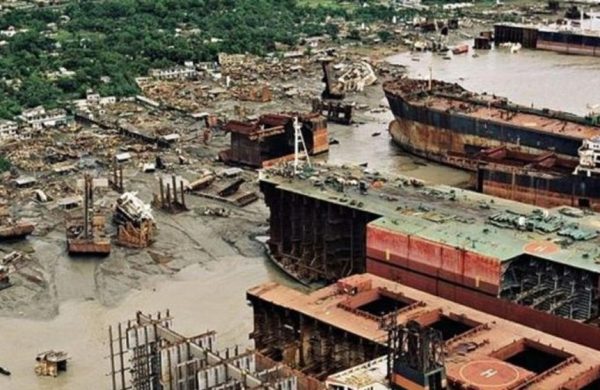
A toxic gas leak at a shipbreaking yard in southeastern Bangladesh has killed nine workers, bringing the industry’s persistent toll to over 130 deaths since 2015 and renewing global scrutiny over recurring fatalities, lax safety enforcement, and hazardous working conditions in the sector.
The tragic incident occurred at the Ferdous Steel yard in Bhatiary, located in Chattogram’s Sitakunda region. The victims were dismantling a decommissioned vessel when they were overcome by poisonous fumes inside an unventilated, confined compartment.
Officials from the Fire Service and Civil Defence confirmed that the ship had previously transported liquefied natural gas (LNG) and should have undergone mandatory gas-freeing certification before torch-cutting operations commenced.
Responding to the tragedy, Md. Mahiuddin, a representative for the yard owner, attributed the deaths to worker “carelessness.” However, labor rights organizations, safety auditors, and decades of official records point to systemic institutional failures—including unmonitored working environments, missing protective equipment, and weak regulatory oversight across Bangladesh’s ship-recycling belt.
Decades of Fatalities and Unchecked Hazards
Data compiled by the Bangladesh Institute of Labour Studies (BILS) reveals that at least 137 workers were killed and 205 injured in accidents across Sitakunda’s shipbreaking yards between 2015 and 2024. The deadliest single year in recent history was 2019, which claimed 23 lives.
The fatal history of the sector extends much further back:
- 2005–2011: More than 90 worker deaths were recorded by the non-governmental organization Young Power in Social Action (YPSA).
- 1995–2015: Approximately 400 workers lost their lives over a two-decade span, according to early YPSA estimates cited in a report prepared for the IMO-NORAD SENSREC project.
Industrial safety experts note that trapped chemical vapors, toxic gas accumulation, and subsequent explosions remain the leading cause of mass-casualty events in these yards.
Sharp Surge in Casualties
Monitoring indicates that workplace hazards in the yards are escalating rather than abating. BILS recorded 28 workplace accidents in the first six months of 2026 alone—an 87% surge compared to the 15 incidents reported during the same period in 2025.
| H1 2026 Occupational Safety Metrics | Key Figures |
| Total Workplace Incidents | 28 (up from 15 in H1 2025) |
| Casualties | 3 fatalities, 25 injuries (10 severe) |
| Peak Month for Incidents | April |
| Most Vulnerable Job Roles | Cutters, fitters, crane helpers, wire-group, and loading crews |
| Primary Incident Drivers | Gas poisoning, chemical fires, falling steel, and crane failures (~80%) |
International Scrutiny and Urgent Calls for Reform
Labor rights groups emphasize that fundamental safety protocols are routinely ignored to cut operational costs. BILS has urged government agencies to mandate certified pre-entry gas testing, formal “permit-to-work” safety management systems, standardized personal protective equipment (PPE), and regular emergency drills.
These findings echo a investigation by Human Rights Watch (HRW), which documented widespread labor violations in Sitakunda. Workers interviewed revealed that they were routinely forced to operate in hazardous, enclosed spaces without standard respirators—sometimes resorting to wrapping their own shirts around their faces to filter out toxic fumes.
Human rights advocates and international maritime organizations continue to call on global shipowners and national authorities to strictly enforce international ship recycling standards to prevent further loss of life.










Editor & Publisher: Golam Mostafa Jibon
News & Commercial Office:
2 R. K Mission Road, Dhaka & Railgate, Sirajganj.
Hotline: 01715-319996, 01558-314179
E-mail : editor.thedailysky@gmail.com
news.thedailysky@gmail.com