

Coal worth 1.9 tr remains underground; reliance on import continues
- Update Time : Sunday, September 13, 2026
Reserves can meet 356 years of demand
Online Desk:
Bangladesh imports majority of its coal from abroad while coal worth Tk 1.9 trillion remains underground due to indecision.
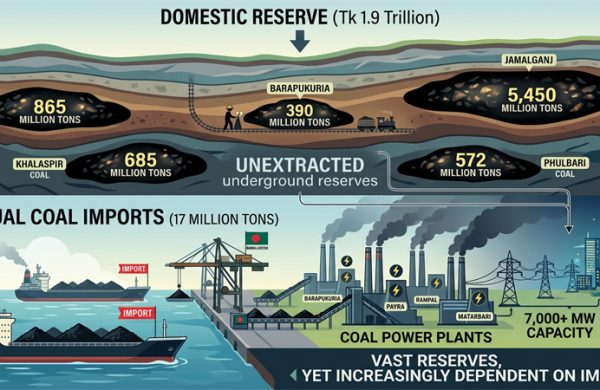
To run the coal-based power plants of Bangladesh, the government has to import around Tk 15,000 to Tk 20,000 crore worth of coal every year, amounting to nearly 17 million tons. These power plants have the maximum capacity of contributing over 7,000 megawatts of energy into the national grid – a supply chain that remains entirely dependent on ocean shipment freights.
However, indecisive government frontier and lack of patronage have provided with isolation of around 7,912 million tons of coal reserve across five coal mines scattered over the country.
According to experts, even if the current annual demand increases to 20 million tons, these reserves could fulfill the nation’s coal needs for at least 356 years. Yet, despite having vast reserves, the country is becoming increasingly dependent on imports.
Past events-such as the Russia-Ukraine war and conflicts in the Middle East have created severe financial strain and crises in the country’s energy supply system. Although the issue of extracting local coal has been raised repeatedly to reduce single-dependency on the gas sector for electricity generation, the government has backed down for unknown reasons.
Energy experts believe that while different political governments came to power over time, none could take major decisions regarding coal extraction.
As a result, reliance on coal imports have gradually increased over time as demands grew, while vast amount of reserve stays buried underground due to policy failures.
According to an official document from the Energy Division, if only 20 per cent of the coal in the country’s five mines were extracted, it would yield 1,564 million tons of coal, which could fulfill the demand equivalent to 40 trillion cubic feet of natural gas. Petrobangla currently imports a large volume of LNG annually, meeting 25 per cent to a maximum of 30 per cent of total gas demand. Importing this gas costs the government nearly Tk 50,000 to Tk 60,000 crore, with subsidies reaching around Tk 20,000 crore.
Electricity generation using domestic coal still offers a huge opportunity to avoid these massive energy expenses.
Energy expert and Independent University professor M Tamim said, “A neutral assessment is required to make a final decision on extracting domestic coal. I believe the entire management of our coal extraction should be thoroughly evaluated by a neutral third party with no vested interests – someone capable from Bangladesh. If they report that the risks are limited and manageable without causing major issues, we can move forward. But if they find the risks to be too high, we should completely abandon the idea of extracting domestic coal.”
Among the country’s five coal fields, Petrobangla currently extracts coal only from the Barapukuria mine. Reports reveal that Barapukuria still holds reserves of 390 million tons. Petrobangla’s subsidiary, Barapukuria Coal Mining Company Limited (BCMCL), extracts up to a maximum of 950,000 tons of coal annually from this mine. From the start of commercial extraction up to the 2025-26 fiscal year, over 16.469 million tons of coal have been extracted.
The deepest coal mine in Bangladesh is located in Jamalganj, Joypurhat, at a depth ranging from 640 to 1,158 meters. Data shows this mine contains reserves of 5,450 million tons. The Geological Survey of Bangladesh (GSB) discovered it in 1959.
Feasibility studies were conducted, however, no state-level decision had been taken even after six decades of its discovery.
Petrobangla has yet to finalize decisions on extraction, technological readiness, or whether to involve foreign companies.
Apart from Barapukuria and Jamalganj, there are three other coal fields. The Dighipara mine in Dinajpur, discovered in 1995, holds 865 million tons of coal reserves.
Khalaspir mine in Rangpur contains 685 million tons, and Phulbari holds 572 million tons.
Sources note that coal prices vary by country. Assuming an average price of $200 per ton (at an exchange rate of 122 BDT per USD), coal worth approximately Tk 1.930528 trillion (Tk 19,30,528 crore) remains unextracted underground.
Commenting on the matter, energy expert and former member (Gas) of the Bangladesh Energy Regulatory Commission, Maqbul-E-Elahi Chowdhury, noted that from the beginning, the primary obstacles were a lack of technological capacity and concerns over environmental impacts. Decisions could not be finalized on how to extract coal while preserving nature. However, with a strong and decisive stance, the country’s coal resources could potentially have been extracted.
According to BPDB data, total electricity generation and imports combined reached approximately 101,187 gigawatt-hours (GWh) in the 2024-25 fiscal year. Cross-border power imports accounted for 16,407 GWh, meaning nearly 16 per cent of the total supply came from abroad. During the same fiscal year, BPDB calculated the average generation cost per unit of electricity at 11.83 BDT, up from 10.96 BDT in the previous year – a cost increase of nearly 8 per cent in one year.
International market analysis indicates that Bangladesh’s coal imports reached nearly 17 million tons in 2025, an increase of about 4.9 million tons over the previous year.
A ray of hope emerged after Prime Minister Tarique Rahman took the office. Present government initiated a long-term plan to resolve the nation’s energy challenges. This long-term framework targets extracting 565 million tons of coal from various domestic fields over the next 10 years.
Under this plan, the government aims to expand the Barapukuria mine and extract roughly 160 million tons of coal between 2031 and 2035. Establishing rail connections to transport extracted coal to power plants across the country is also under consideration, including plans for new rail tracks if needed.
Furthermore, given existing infrastructure for coal imports and power generation, the government is considering installing additional coal-based power units at Matarbari.
According to government timelines, expansion efforts at the Barapukuria coal mine will begin between 2026 and 2030, with a target to extract around 160 million tons from Barapukuria between 2031 and 2035. There is also a target to implement a comprehensive Coal Policy by June 2028.
Nevertheless, experts emphasize that having raw coal reserves alone is not enough; an integrated plan is essential-covering economically viable reserves, extraction technologies, environmental impact assessment, water management, rehabilitation, and the transport infrastructure required to deliver extracted coal to power plants.
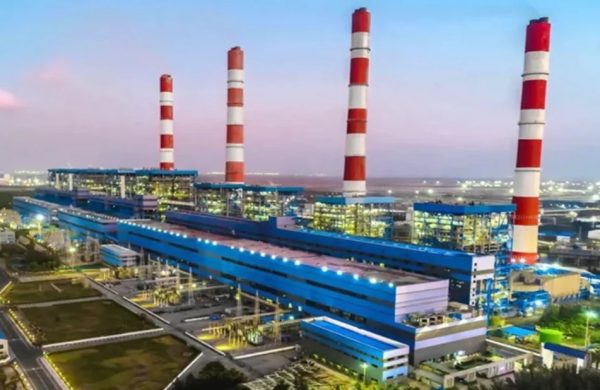
Major commercial coal-fired power plants currently operational in Bangladesh include the Barapukuria Coal Power Plant in Dinajpur, Payra Thermal Power Plant, Rampal Thermal Power Plant, Matarbari Coal Power Plant in Moheshkhali, and SS Power Plant in Banshkhali. Together, these plants have a combined generation capacity exceeding 5,700 megawatts. Additionally, an RPCL-NORINCO coal-fired power plant with a 1,200 MW capacity is located in Patuakhali.
Individually, Barapukuria has a total capacity of approximately 525 MW, Payra Thermal Power Plant 1,320 MW, Rampal 1,320 MW, and Matarbari 1,200 MW. The SS Power Plant in Banshkhali has a capacity of 1,320 MW, alongside RPCL’s 1,200 MW facility.








Editor & Publisher: Golam Mostafa Jibon
News & Commercial Office:
2 R. K Mission Road, Dhaka & Railgate, Sirajganj.
Hotline: 01715-319996, 01558-314179
E-mail : editor.thedailysky@gmail.com
news.thedailysky@gmail.com