

Dhaka residents increasingly concerned over multiple forms of crime
- Update Time : Saturday, September 26, 2026
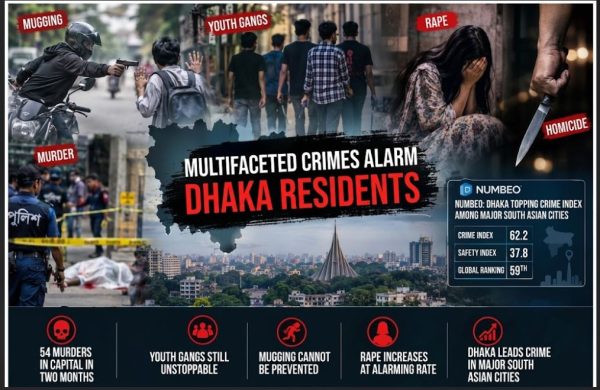
- 54 murders reported in capital in two months
- Snatching, gang culture and sexual violence remain major concerns
Raaz Mostafa:
Dhaka residents are increasingly concerned over a deteriorating law-and-order situation as violent crime, snatching, youth gang activity and sexual violence continue to pose serious challenges in the capital.
Crimes ranging from daylight killings and armed snatching to the recovery of dismembered bodies have been reported in recent months, while new forms of cybercrime are also emerging.
The situation has also drawn attention from international crime-monitoring platforms. According to Numbeo’s 2026 Crime Index, Dhaka has a crime index of 62.24 and a safety index of 37.76, placing it at the top of the South Asian cities listed by the platform for crime levels. Delhi has a crime index of 59.05, followed by Ghaziabad at 58.38 and Karachi at 57.46.
Numbeo’s figures are based on its own crowd-sourced data and perception-based methodology, rather than official police statistics. Nevertheless, the findings have added to concerns over public safety in the capital.
Rape cases on the rise
Recent human rights monitoring data also show an increase in reported rape cases.
According to the Manabadhikar Shongskriti Foundation (MSF), 306 incidents of violence against women and children were recorded in July, compared with 320 in June. However, rape cases increased sharply from 68 in June to 90 in July. Cases of sexual assault or harassment also rose from 21 to 22, while reported suicides increased from 17 to 28.
At the same time, some categories of violence declined. Gang rape cases fell from 16 to seven, physical assault from 56 to 42, and killings from 76 to 52, according to the MSF report.
The figures are based on reports published in national newspapers and information collected from human rights activists, according to MSF.
Dhaka grapples with snatching
Snatching has emerged as another major concern in Dhaka, with armed groups reportedly operating in different parts of the city.
A recent incident in Uttara involving the alleged snatching of more than Tk1.25 crore from a business establishment has further heightened concern over the security situation. Police had yet to make an arrest in the case, according to the report.
According to information cited in the report, 1,387 listed snatchers are currently active in the eight divisions of the Dhaka Metropolitan Police (DMP), compared with 989 six months earlier.
The figures reportedly include 152 in Ramna, 159 in Lalbagh, 308 in Wari, 168 in Motijheel, 240 in Tejgaon, 53 in Mirpur, 67 in Gulshan and 240 in Uttara.
Police sources say many of those listed have multiple cases against them and have been arrested more than once before returning to criminal activity after securing bail.
The report also estimates that more than 1,000 snatchers outside the official list may be active in the capital, including floating youths and drug users who allegedly carry knives, machetes and other weapons.
More than 300 snatching-prone locations have reportedly been identified in Dhaka, including 55 hotspots. Tejgaon has the highest number of such hotspots, followed by Motijheel and Wari.
Law-enforcement officials have acknowledged the challenge of preventing snatching even after identifying vulnerable locations. Many incidents may also remain unreported because victims do not file general diaries or cases.
Youth gangs remain a major challenge
The activities of so-called teenage gangs have also continued to alarm residents.
Akash, described as a gang leader in Mohammadpur, was arrested seven times before obtaining bail about eight months ago. The accused, who reportedly faces 12 cases, allegedly returned to criminal activity after his release and was recently arrested again.
The problem, however, extends beyond a single individual.
According to figures cited by law-enforcement agencies and other organisations, the number of teenage gang groups in Bangladesh increased from 173 in 2022 to 237 in 2024. Police records reportedly list 2,382 members of such groups, including 127 groups that remain active in Dhaka.
The groups have allegedly become involved in crimes ranging from eve-teasing, theft and snatching to extortion, drug trading and murder. Some local political figures have also been accused of providing protection or acting as so-called “big brothers” to members of these groups.
Dhaka Metropolitan Sessions Judge’s Court Public Prosecutor Omar Faruk Faruqi said many cases involving juvenile gang members are bailable, making it difficult to keep accused youths in custody for long periods.
He also said witnesses sometimes fail to appear before courts, delaying trials.
“Separate courts for children should be established so that such cases can be disposed of more quickly,” he said.
54 murders in Dhaka in two months
A series of gruesome killings has further deepened public concern.
Videos of attacks using locally made weapons have circulated on social media, contributing to growing anxiety over public safety. Dismembered bodies have also recently been recovered from two locations in the capital, while several killings have allegedly involved professional hitmen.
According to figures attributed to the Police Headquarters, 54 murders were reported in Dhaka and 624 across Bangladesh over the past two months.
The broader law-and-order situation has also been complicated by mob violence. MSF reported 66 incidents of mob violence nationwide in July, in which 31 people were killed and 58 injured.
Police response under scrutiny
Law-enforcement agencies have been under pressure to contain the growing range of crimes in the capital.
DMP continues to conduct regular anti-crime operations, with hundreds arrested in periodic drives. In one 24-hour operation in July, for example, police arrested 432 people across Dhaka and filed 54 cases.
However, crime analysts say arrests alone cannot address the underlying problems.
Dr Touhidul Haque, an associate professor at the University of Dhaka’s Institute of Social Welfare and Research, said the police play a crucial role in maintaining law and order but have faced difficulties in fully adapting to the changing criminal landscape.
“Criminal networks have changed, and there are gaps in law-enforcement efforts to keep pace with them,” he said.
Regarding teenage gangs, he said the problem could not be addressed by law-enforcement agencies alone.
“Families, educational institutions and society as a whole must work together to tackle the culture of teenage gangs,” he said.
With violent crime, snatching, youth gangs and sexual violence continuing to generate concern, the challenge for Dhaka now lies not only in increasing arrests but also in strengthening prevention, investigation, prosecution and community-level intervention.








Editor & Publisher: Golam Mostafa Jibon
News & Commercial Office:
2 R. K Mission Road, Dhaka & Railgate, Sirajganj.
Hotline: 01715-319996, 01558-314179
E-mail : editor.thedailysky@gmail.com
news.thedailysky@gmail.com